A.I. PRIME - Article
The Future of Agentic AI in Enterprise Automation: Trust, Control, and Value
Explore how agentic AI solutions transform enterprise automation while balancing autonomy with governance, risk management, and measurable business impact.
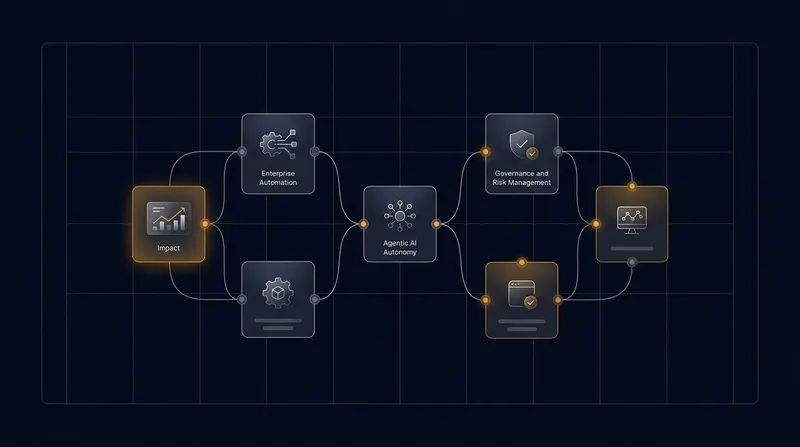
Enterprise leaders face a defining challenge in 2026 and beyond: how to harness the transformative power of agentic AI solutions while maintaining the governance, oversight, and risk management that boards and regulators demand. The promise is compelling - autonomous agents that learn, adapt, and execute complex workflows without constant human intervention, delivering measurable ROI in weeks rather than quarters. Yet the tension between autonomy and control remains unresolved for most organizations. Chief Digital Officers, CTOs, and operations leaders are caught between the imperative to innovate and the responsibility to ensure every AI-driven decision remains auditable, explainable, and aligned with business objectives. This post explores how agentic AI will reshape enterprise operations, the critical trade-offs you must navigate, and the strategic priorities that will separate market leaders from laggards.
What Agentic AI Solutions Really Mean for Enterprise Operations
Agentic AI represents a fundamental shift from reactive automation to proactive intelligence. Unlike traditional RPA or rule-based systems that execute predefined workflows, agentic AI solutions operate with degrees of autonomy - they observe patterns, make contextual decisions, adapt to new conditions, and escalate exceptions intelligently. This distinction matters profoundly for enterprise operations. Learn more in our post on Agentic AI Solutions for Business: Packages, Use Cases, and ROI Estimates.
Consider a typical accounts payable workflow. Legacy automation might extract invoice data, match it to purchase orders, and flag discrepancies for human review. An agentic AI solution does all that - and more. It learns from historical approval patterns, understands vendor behavior, detects anomalies in real time, negotiates payment terms autonomously within approved parameters, and proactively manages cash flow optimization. The agent operates continuously, improving its decision-making as it processes thousands of transactions, all while maintaining a transparent audit trail that compliance teams can inspect.
This shift unlocks three critical operational advantages. First, velocity - processes that once took days now complete in hours or minutes, with minimal human handoff. Second, scalability - agents handle volume spikes without proportional cost increases, since they don't fatigue or require shift management. Third, insight generation - agents become sensors for operational intelligence, surfacing patterns and opportunities that humans would miss in raw data.
The organizations that win with agentic AI won't be those that deploy the most agents, but those that deploy agents with the right guardrails, transparency, and alignment to business outcomes.
For mid to large enterprises, the operational impact extends across functions. Sales teams deploy agents that qualify leads, personalize outreach, and manage follow-ups autonomously - freeing account executives to focus on complex negotiations and relationship building. Manufacturing operations use agents to predict equipment failures, optimize production schedules, and coordinate supply chain logistics in real time. Finance teams leverage agents for forecasting, variance analysis, and strategic planning support. The common thread: humans remain in control of strategy and judgment, while agents handle execution and continuous optimization.
However, this operational transformation introduces a new category of risk. When agents operate with autonomy, they can amplify errors at scale. A misconfigured pricing agent might inadvertently undercut margins across thousands of transactions. A poorly governed hiring agent might encode bias into candidate screening. An unmonitored customer service agent might make commitments that violate service level agreements. These aren't theoretical concerns - they're the defining governance challenges of the agentic AI era.
The Autonomy vs. Oversight Trade-off: Where Most Organizations Get Stuck
The central tension in agentic AI deployment is architectural: the more autonomy you grant agents, the more value they unlock, but the more risk you introduce. Conversely, heavy oversight and guardrails reduce risk but also constrain the upside that makes agentic AI worth implementing in the first place. Learn more in our post on Governed AI Guardrails: Implementing Compliant Oversight for Agentic Systems.
Most enterprises approach this trade-off reactively, starting with maximum autonomy and adding guardrails after problems surface. This is backwards. The organizations capturing durable value from agentic AI solutions are those that design governance into the architecture from day one.
Consider three governance models, each with distinct trade-offs:
-
Human-in-the-Loop (HIL) - Agents make recommendations; humans approve before execution. This maximizes oversight but minimizes the speed and scale benefits that justify agentic AI investment. HIL is appropriate for high-stakes decisions (approvals above threshold amounts, hiring decisions, customer escalations), but it bottlenecks the workflow if applied too broadly. The risk: you end up with expensive software that doesn't actually automate anything meaningful.
-
Monitored Autonomy - Agents execute within predefined boundaries, with real-time monitoring and exception handling. This is the sweet spot for most enterprise use cases. Agents have autonomy to act, but only within parameters that reflect business rules, risk tolerance, and compliance requirements. Violations trigger immediate alerts and escalation. This model requires robust observability - you need dashboards that show agent decisions, confidence levels, and outcomes in real time.
-
Autonomous with Audit - Agents operate with full autonomy, but every decision is logged, auditable, and subject to retroactive review. This maximizes value but demands exceptional governance infrastructure. It works for lower-risk, high-volume decisions (customer service responses, content generation, internal process optimization) but is inappropriate for financial, legal, or safety-critical domains without additional safeguards.
The mistake most organizations make is choosing one model globally. Mature agentic AI deployments use all three, matched to decision type and risk profile. A sales agent might operate autonomously on follow-up timing and messaging (low risk, high volume), require human approval for discounts above 15% (moderate risk, moderate volume), and escalate contract modifications to legal (high risk, low volume).
This requires what we call dynamic governance - the ability to adjust agent autonomy in real time based on performance, market conditions, and organizational learning. If an agent's error rate spikes, the system automatically tightens constraints. If an agent consistently outperforms expectations, the system expands its decision boundary. This adaptive approach treats governance not as a static compliance checkbox, but as a living system that evolves with the agent's maturity and your confidence in its decision-making.
The best agentic AI solutions don't hide complexity behind a simple "autonomous" or "monitored" label. They provide granular control over each agent's decision authority, with real-time visibility into how that authority is being exercised.
Another critical trade-off involves transparency. Agentic AI solutions that maximize autonomy often rely on deep learning models that operate as "black boxes" - they make decisions that are difficult or impossible to explain. This creates a fundamental conflict with regulatory requirements in finance, healthcare, and other regulated industries. A loan approval agent might deny an applicant based on patterns it learned from historical data, but if it can't explain why, the organization faces legal exposure.
Forward-thinking enterprises are prioritizing explainability in agentic AI solutions, even if it means accepting slightly lower accuracy. They're using interpretable machine learning models, maintaining decision logs, and building agent systems that can articulate their reasoning in human terms. This isn't just about compliance - it's about maintaining organizational trust in the systems that are increasingly driving business outcomes.
Building Durable Competitive Advantage: Strategic Priorities for CDOs
The organizations that will capture durable competitive advantage from agentic AI solutions aren't those that adopt the technology fastest. They're those that align agentic AI with their business model, culture, and operational capabilities in ways that are difficult to replicate. Learn more in our post on Building Autonomous AI Agents for Customer Service Automation.
This requires CDOs and technology leaders to prioritize strategically. Here are the five areas where competitive advantage concentrates:
1. Agent Network Architecture and Orchestration
Most organizations deploy agentic AI solutions as isolated point solutions - a sales agent here, a customer service agent there. This misses the exponential value that emerges when agents work together. The future belongs to organizations that build agent networks - interconnected systems where agents collaborate, share context, and coordinate outcomes.
Imagine a scenario: a customer service agent detects that a customer is dissatisfied with product performance. It immediately alerts a product engineering agent, which analyzes usage patterns and identifies a configuration issue. Meanwhile, a sales agent is notified to check if the customer is at contract renewal, and a support agent is queued to proactively reach out with a fix. All of this happens in minutes, across multiple departments, without human coordination.
Building this capability requires investment in orchestration platforms that can route context between agents, manage dependencies, and coordinate outcomes across functional silos. It also requires rethinking organizational structure - agentic AI solutions work best when they align with how work actually flows, not how org charts are drawn.
2. Data Quality and Governance Infrastructure
Agentic AI solutions are only as good as the data they learn from. Organizations with pristine data governance, clear data lineage, and high-quality data pipelines will see their agents make better decisions faster. Those with messy data will see agents amplify historical biases and errors at scale.
This means prioritizing data orchestration services that ensure agents have access to clean, current, contextualized information. It means implementing data quality frameworks that catch drift and degradation before agents make decisions based on bad inputs. It means establishing data governance policies that agents themselves can interpret and enforce.
The competitive advantage accrues to organizations that treat data infrastructure not as a cost center, but as the foundation of agentic AI value creation.
3. Rapid Experimentation and Continuous Enablement
Agentic AI solutions create optionality - you can test new agent behaviors, decision rules, and workflows quickly without requiring months of development and testing. Organizations that institutionalize rapid experimentation will identify winning use cases and scale them before competitors catch up.
This requires building internal capabilities for agent design and deployment. It means training business process managers, not just data scientists, to understand how agents work and what's possible. It means creating feedback loops where frontline teams can suggest agent improvements and see them implemented in days, not quarters.
The organizations winning with agentic AI are those that treat agent development as a core competency, not a specialized IT function.
4. ROI Tracking and Value Attribution
It's easy to deploy agents and claim success. It's hard to prove that agents actually drove incremental value. Organizations that implement rigorous ROI tracking - measuring agent impact on cycle time, cost, quality, and revenue - will make better investment decisions and build organizational credibility for continued funding.
This requires defining clear metrics for each agent before deployment, establishing baselines, and tracking performance continuously. It means building dashboards that show not just agent activity, but agent impact on business outcomes. It means being honest about failures - some agents won't deliver expected value, and that's okay if you learn quickly and reallocate resources.
The competitive advantage goes to organizations that can articulate, with precision, what agentic AI is delivering and what it's costing.
5. Trust and Organizational Change Management
The biggest barrier to agentic AI adoption isn't technical - it's organizational. Employees worry about job security. Managers worry about losing control. Executives worry about liability. Customers worry about interacting with machines instead of humans.
Organizations that invest in change management, transparent communication about how agentic AI will be used, and retraining programs for displaced roles will move faster and encounter less resistance. They'll also unlock more value - employees who understand and trust the systems they work alongside are more likely to suggest improvements and catch problems.
This means CDOs need to be not just technology leaders, but organizational psychologists. You need to communicate why agentic AI matters, how it will be governed, and what it means for different roles and career paths.

Practical Implementation: From Strategy to Execution
Understanding the strategic importance of agentic AI solutions is one thing. Actually implementing them successfully is another. Most organizations fail not because they choose the wrong technology, but because they approach implementation in the wrong sequence.
Here's a framework that works:
Phase 1: Assess and Align (Weeks 1-4)
Start by identifying high-impact, low-complexity use cases where agentic AI can deliver quick wins. Look for processes that are high-volume, repetitive, have clear success metrics, and don't require extensive customization. A good first use case might be customer service follow-ups, lead qualification, or invoice processing - not your most complex, highest-stakes process.
Simultaneously, establish governance frameworks before you deploy anything. Define what autonomy levels different agent types can have. Establish monitoring and escalation protocols. Identify compliance requirements. Align stakeholders on success metrics. This groundwork prevents expensive rework later.
Phase 2: Pilot and Learn (Weeks 5-12)
Deploy your first agentic AI solution in a controlled environment with real data and real users, but with safety guardrails in place. Run it in parallel with your existing process so you can compare outcomes. Measure everything - agent decisions, error rates, user satisfaction, time savings, cost impact.
The goal isn't to prove that agentic AI works - it does. The goal is to understand how it works in your specific context, what edge cases you need to handle, and what your team needs to learn to operate it effectively.
Phase 3: Scale and Optimize (Weeks 13-26)
Once you've validated the use case and refined the agent's behavior, scale it across your organization. As volume increases, you'll discover new edge cases and opportunities for optimization. Implement continuous monitoring to track agent performance and catch degradation early.
Use this phase to build internal capability - train your team to manage and improve agents without constant vendor support. Start planning your second use case, applying lessons from the first.
Phase 4: Network and Integrate (Months 6+)
As you accumulate multiple agentic AI solutions, begin connecting them into networks where agents collaborate. This is where exponential value emerges. A customer service agent might trigger a billing agent to investigate pricing questions, which triggers a contract agent to check terms, which triggers a sales agent to identify upsell opportunities - all in seconds, all coordinated.
At this stage, you're also refining governance based on real-world performance. You've built organizational muscle memory around how to deploy and manage agents. You're starting to see the competitive advantage accruing - your processes are faster, more consistent, and more intelligent than competitors who are still in early pilots.
Throughout this journey, the role of governance cannot be overstated. Agentic AI solutions that lack proper governance frameworks don't scale - they amplify risk. But governance that's too heavy strangles the autonomy that makes agentic AI valuable. The organizations winning with agentic AI are those that treat governance as an enabler, not a constraint.
The future of enterprise automation belongs to organizations that can balance innovation velocity with risk management, autonomy with oversight, and technological sophistication with organizational clarity.
The Competitive Landscape: Who's Ahead and Why
Early leaders in agentic AI deployment - primarily in technology, finance, and e-commerce sectors - are already seeing measurable competitive advantages. They're processing transactions faster, serving customers more responsively, and making better decisions with less human overhead. They're also building organizational capabilities that become harder for competitors to replicate over time.
The next wave of adoption will likely come from industries with high operational leverage - manufacturing, logistics, healthcare, telecommunications. These sectors have processes that are sufficiently structured for agentic AI to add value, but sufficiently complex that human judgment remains essential. They also have significant cost pressures that create urgency for automation.
The laggards will be organizations that either move too slowly (missing the window where first-mover advantages are meaningful) or that deploy agentic AI solutions without proper governance infrastructure (creating crises that set back adoption across their industry).
The critical insight: agentic AI is not a technology problem anymore. It's an organizational and governance problem. The companies that solve those problems first will own disproportionate market share in their categories.
This creates an interesting dynamic for CDOs and technology leaders. You're no longer just evaluating vendors and technologies. You're building organizational capabilities, governance frameworks, and change management strategies that will determine whether agentic AI becomes a source of competitive advantage or competitive liability.

Critical Risks and How to Mitigate Them
Deploying agentic AI solutions introduces new categories of risk that traditional IT governance frameworks don't adequately address. Understanding these risks and building mitigation strategies is essential for responsible deployment.
Model Drift and Performance Degradation - Agents trained on historical data can perform poorly when market conditions, customer behavior, or business rules change. An agent trained on pre-pandemic customer service patterns might be tone-deaf to current expectations. A pricing agent trained on stable market conditions might make poor decisions during volatility.
Mitigation: Implement continuous monitoring that tracks agent performance against baselines. Set up automated alerts when performance degrades. Establish regular retraining schedules and processes for updating agent decision rules based on new data.
Bias Amplification - If your training data contains historical bias (e.g., hiring discrimination, lending bias), agents will learn and amplify that bias at scale. A recruitment agent might systematically disadvantage certain demographics. A credit scoring agent might encode historical discrimination into approval decisions.
Mitigation: Audit training data for bias before deploying agents. Implement bias detection tests that run continuously. Establish human review processes for high-stakes decisions. Be transparent about agent limitations and maintain human oversight for decisions that significantly impact individuals.
Cascading Failures - When agents are interconnected in networks, a failure in one agent can propagate through the system. A misconfigured pricing agent might feed bad data to a revenue forecasting agent, which feeds bad data to a resource planning agent, which makes poor hiring decisions.
Mitigation: Design agent networks with circuit breakers and isolation mechanisms. Implement validation layers that catch bad data before it propagates. Build observability so you can trace failures back to their root causes quickly.
Regulatory and Compliance Exposure - Agentic AI solutions that make autonomous decisions in regulated domains face significant legal risk. A loan approval agent that can't explain its decisions violates fair lending regulations. An insurance pricing agent that uses protected characteristics faces discrimination lawsuits.
Mitigation: Involve compliance and legal teams early in agent design. Prioritize explainability and auditability. Maintain human oversight for decisions that significantly impact customers or involve regulated domains. Document agent behavior and decision rules thoroughly.
Security and Data Exposure - Agents that operate autonomously need access to sensitive data and systems. If not properly secured, they can become vectors for data theft or system compromise. An agent that's compromised could exfiltrate customer data or modify financial records.
Mitigation: Implement zero-trust security principles for agent access. Use role-based access control to limit what data and systems each agent can access. Monitor agent behavior for anomalies that might indicate compromise. Implement encryption and audit logging for all agent activities.
These risks are real, but they're manageable with proper governance. The organizations that will win with agentic AI solutions are those that take risk seriously and build mitigation into their architecture from day one.
Measuring Success: Beyond Activity to Impact
One of the biggest mistakes organizations make with agentic AI solutions is measuring success by activity rather than impact. They track how many transactions agents processed, how many hours they saved, how many decisions they made - but they don't connect those activities to business outcomes.
This matters because it leads to misallocated investment. You might deploy an agent that processes thousands of transactions but delivers minimal value because those transactions were already handled efficiently. Meanwhile, you miss opportunities to deploy agents that would dramatically improve customer experience or accelerate revenue growth.
Here's a framework for measuring agentic AI impact:
Define Baseline Metrics - Before deploying an agent, establish how the process currently works. How long does it take? What does it cost? What's the error rate? What's the customer satisfaction? These baselines let you measure incremental impact.
Identify Leading Indicators - These are metrics that agents directly influence and that you can track in real time. For a sales agent, leading indicators might be number of qualified leads, response time, or meeting bookings. For an operations agent, they might be process cycle time, error rate, or resource utilization.
Track Lagging Indicators - These are the business outcomes that ultimately matter. Revenue, customer satisfaction, cost per transaction, employee retention, time to market. Leading indicators should correlate with lagging indicators - if they don't, your agent isn't actually driving business value.
Account for Indirect Effects - Agents often create value beyond their primary function. A customer service agent that resolves issues quickly might increase customer lifetime value. A sales agent that improves lead quality might increase deal size. These indirect effects are often larger than direct effects, but they're harder to measure and easy to miss.
Implement Continuous Measurement - Don't wait for quarterly reviews to assess agent impact. Build dashboards that show performance in real time. This lets you catch problems early and identify optimization opportunities quickly.
The organizations that master this measurement discipline will allocate their agentic AI investments more effectively and build stronger business cases for continued funding.
The Road Ahead: What's Coming in Agentic AI Solutions
The agentic AI landscape is evolving rapidly. Several trends are worth monitoring as you plan your strategy:
Multimodal Agents - Current agents primarily work with structured data and text. Future agents will seamlessly integrate vision, audio, video, and other modalities. A customer service agent might watch a video of a customer's problem and understand it better than reading a transcript. A manufacturing agent might identify equipment failures by analyzing thermal imaging.
Reasoning and Planning Capabilities - Today's agents are primarily pattern-matching systems. Future agents will incorporate explicit reasoning and planning, allowing them to solve novel problems and explain their thought process. This will expand the domains where agentic AI can add value.
Collaborative Human-Agent Teams - Rather than agents replacing humans, the future is likely to be deeply collaborative. Agents handle routine decisions and execution while humans focus on strategy, creativity, and judgment. The organizations that design these collaborative workflows effectively will outperform those that try to maximize automation.
Decentralized Agent Networks - As agent deployments scale, organizations will move from centralized agent platforms to decentralized networks where agents operate semi-autonomously and coordinate through peer-to-peer communication. This will improve resilience and scalability but requires new governance approaches.
Regulatory Frameworks - Governments are beginning to regulate AI more explicitly. Organizations that build governance and explainability into their agentic AI solutions now will be better positioned to adapt to regulatory requirements as they emerge.
None of these trends eliminate the fundamental challenges of deploying agentic AI solutions. They just shift the nature of those challenges. The organizations that stay ahead will be those that continuously evolve their governance frameworks, measurement approaches, and organizational capabilities to keep pace with the technology.
Conclusion: Your Next Steps
The future of enterprise automation is agentic. The organizations that deploy agentic AI solutions strategically, with proper governance and clear focus on business impact, will capture significant competitive advantages. But this isn't a technology decision - it's a business and organizational decision.
If you're a CDO, CTO, or operations leader responsible for digital transformation, here's what you should do next:
First, assess your organization's readiness for agentic AI solutions. Do you have the data quality, governance infrastructure, and change management capabilities to deploy agents responsibly? If not, start building those foundations now.
Second, identify your highest-impact, lowest-complexity use cases. These are where you'll pilot agentic AI solutions and build organizational muscle memory. Look for processes that are high-volume, repetitive, have clear success metrics, and don't require extensive customization.
Third, establish governance frameworks before you deploy anything. Define autonomy levels, monitoring protocols, escalation procedures, and compliance requirements. This groundwork prevents expensive rework later and builds organizational confidence in agentic AI solutions.
Fourth, partner with providers who understand that agentic AI is as much about governance as it is about technology. Look for partners who offer not just autonomous agents, but the orchestration platforms, monitoring dashboards, and governance frameworks you need to deploy agents responsibly at scale.
At A.I. PRIME, we specialize in exactly this challenge. We help mid to large enterprises design and deploy agentic AI solutions that balance innovation velocity with risk management. We provide the workflow design expertise, automation blueprinting, governance integration, and continuous enablement support that turns agentic AI from a promising technology into a source of durable competitive advantage.
Our approach combines autonomous workflow orchestration with governed AI guardrails, real-time insight loops with ROI tracking, and rapid deployment with rigorous change management. We work with your team to understand your specific challenges, design agent networks that align with your business model, and build the organizational capabilities you need to operate these systems effectively.
If you're ready to explore how agentic AI solutions can accelerate your digital transformation and drive measurable business impact, let's talk. We offer comprehensive AI consulting, workflow design, and agent network deployment services tailored to your industry and operational context. Our goal is to help you capture the competitive advantages that agentic AI makes possible while managing the risks responsibly.
The future of enterprise automation is being written now. The organizations that understand the strategic importance of agentic AI solutions, that invest in proper governance and organizational capabilities, and that measure impact rigorously will lead their industries. The question isn't whether your organization will adopt agentic AI - it's when, and whether you'll be ahead of or behind your competition when you do.
Next step
Book the Opportunity Sprint