A.I. PRIME - Article
Custom Integrations: Connect Agentic AI to Legacy Systems Without Disruption
Practical guidance on agentic AI integration with legacy systems including middleware patterns, a Q3 migration timeline, security and testing strategies.
Why Agentic AI Integration Matters for Your Operations
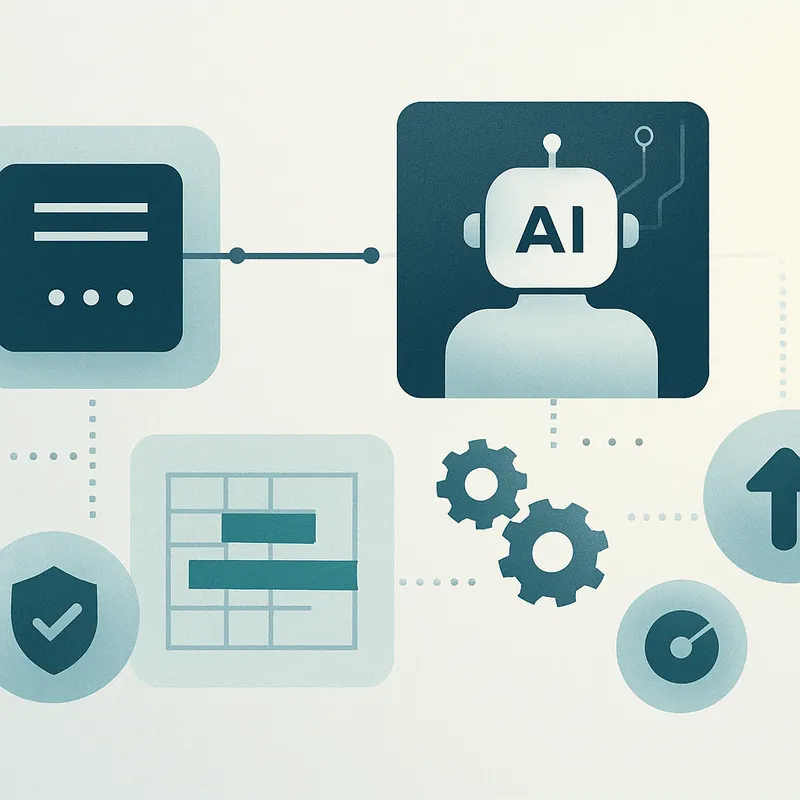
Integrating agentic AI into your legacy systems is one of the most impactful moves you can make in 2025. Agentic AI brings autonomous agents that orchestrate tasks, make decisions, and interact with your existing systems without requiring you to tear down what's already working. When connected properly, these agents dramatically reduce manual work, accelerate decision cycles, and unlock insights from data that's been trapped in siloed systems. Learn more in our post on Custom Integrations: Connect Agentic AI to Legacy Systems Without Disruption.
The challenge is real: legacy systems were rarely designed for real-time programmatic interaction. They run on-premise, use proprietary protocols, and enforce rigid schemas that complicate direct integration. Without a deliberate strategy, you risk degrading critical services or compromising data integrity during the transition.
The good news is that agentic AI integration doesn't require a rip-and-replace. A layered architecture that isolates risk, non-invasive middleware, and strong observability let you add AI capabilities on top of your existing infrastructure. The organizations that have done this successfully report faster cycle times for key tasks, better decision quality powered by real-time context, and higher satisfaction from reduced friction in workflows.
What You'll Gain
- Operational acceleration - Automate repetitive tasks and orchestration across systems without manual intervention.
- Better data utilization - Agents read, reconcile, and act on data in legacy stores that were previously hard to access.
- Lower risk - Embed validation and business rules in middleware rather than modifying critical systems directly.
- Faster innovation cycles - Iterate on agents independently and layer them on top of your existing stack.
Integration Approaches That Keep Your Systems Stable
There are three primary patterns for connecting agentic AI to legacy databases and on-premise systems. Each has different trade-offs in latency, development effort, and operational risk. The right choice depends on your use case urgency, compliance constraints, and how mature your IT processes are. Learn more in our post on How to Assess Your Legacy Systems for Agentic AI Integration.
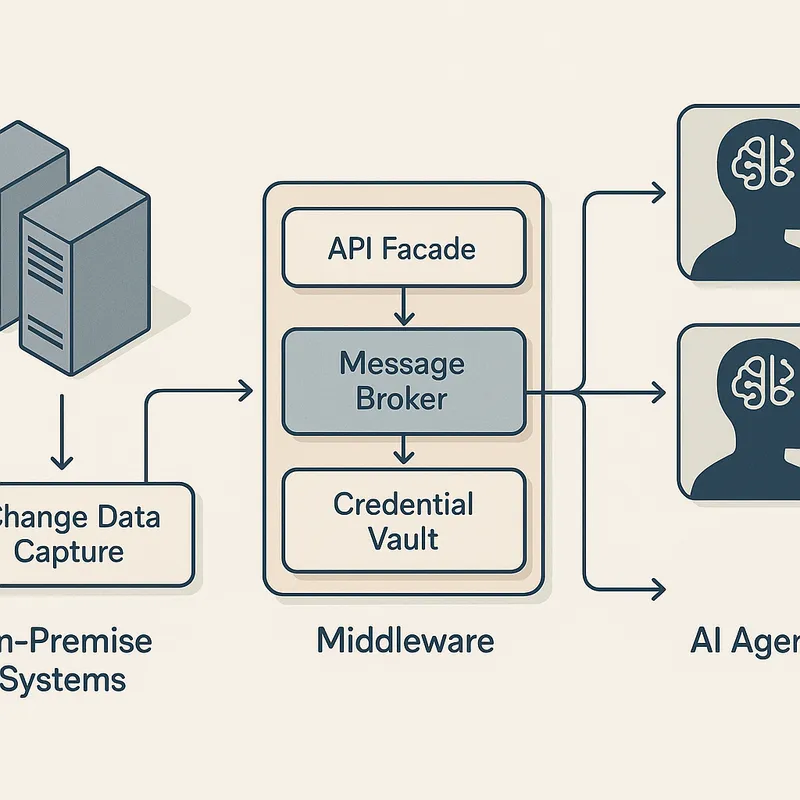
Non-invasive middleware is often the safest starting point. This approach uses adapters that poll or receive events from your legacy systems, transform data into standard structures, and expose secure interfaces to your agentic layers. Because it doesn't touch your legacy codebase, it minimizes the chance of breaking production. Non-invasive middleware is ideal for pilots that need contextual data but cannot tolerate any interruption to business processes.
API facade patterns wrap legacy functionality with a controlled API layer. This standardizes interaction and enforces contracts, so agentic agents call well-defined endpoints. A facade reduces complexity for agent design because it presents consistent semantics across disparate systems. It also enables throttling, authentication, and schema evolution without touching the underlying system. Implement facades when your team can coordinate limited changes or when a gateway provides protocol translation on behalf of the legacy system.
Hybrid Connectors for Low-Latency Actions
Hybrid connectors provide direct but gated access to legacy systems where read or write latency is critical. This approach uses secure tunnels, credential vaulting, and immutable transaction logging to satisfy audit and compliance requirements. Hybrid connectors are appropriate when agentic AI requires low-latency reads or must execute near-real-time operations such as order routing or inventory adjustments. Always implement strong circuit breakers and fallbacks so that if the agentic layer fails, your legacy system remains stable.
Middleware selection is decisive for minimizing downtime during migration. Use message brokers, change data capture platforms, and lightweight orchestration layers to decouple agents from legacy endpoints. Design middleware to be observable, idempotent, and testable so you can incrementally validate behavior. Consistent interface contracts and a robust schema registry maintain compatibility as both agentic and legacy components evolve.
Data Architecture and Security for Safe Connection
Data is the foundation of agentic AI effectiveness. Connecting agents to legacy databases requires a thoughtfully designed data architecture that ensures data quality, lineage, and privacy. Before any live agent has write capability, build a read-only layer that supplies sanitized context, derived features, and precomputed summaries. This reduces the surface area for accidental writes and provides a controlled way to validate agent decisions against historical outcomes. Learn more in our post on Security and Compliance for Agentic AI Automations.
Data mapping is critical when different systems use conflicting identifiers and inconsistent taxonomies. Use canonical data models to normalize formats and centralize reconciliation logic in middleware. Implement transformation pipelines that preserve original timestamps and provenance metadata so that any decision by an agent can be traced to the original records. This provenance supports auditability and enables post-event analysis when something unusual happens.
Security is non-negotiable. Agentic AI integration with legacy systems must follow least-privilege principles, enforce role-based access controls, and use secure credential management systems. Network segmentation is often required for on-premise systems. Apply strict ingress and egress controls and use data masking or tokenization for sensitive attributes. Where regulations require it, ensure that data stays within geographic boundaries and that encryption keys are managed with an auditable key lifecycle.
Operational Controls That Reduce Risk
Operational readiness means deploying observability across the entire data path. Implement metrics for latency, error rates, and throughput between agents and legacy endpoints. Create synthetic transactions that mirror critical workflows so you detect regressions before they affect customers. For write actions initiated by agents, require staged approval or canary rollout that escalates to automatic remediation if thresholds are exceeded. These controls reduce the risk that agentic AI integration will produce disruptive outcomes.
A decision sandbox is another useful control. Route agent decisions to a shadow environment where the decision is scored against expected outcomes without changing production data. Shadowing enables teams to assess agent accuracy and impact, tune models and rules, and build confidence for live action. Use the results from shadow deployments to refine mapping logic, retry strategies, and compensating transactions.
Q3 Migration Timeline That Minimizes Downtime
Planning a migration in Q3 requires aligning stakeholders, securing maintenance windows, and defining clear rollback criteria. The timeline below covers a typical 12-week Q3 migration window that can be compressed or extended depending on system complexity. The schedule emphasizes incremental validation and time-boxed canary releases so downtime is minimized and recoverability is guaranteed.
Weeks 1 to 2: Preparation and discovery. Inventory your systems, data stores, and interfaces. Identify critical paths and define success metrics. Create a separation plan that explicitly lists what will change in the legacy environment and what will remain untouched. Assign owners for each integration touchpoint and establish communication channels for incident escalation.
Weeks 3 to 4: Middleware deployment and interface stabilization. Deploy non-invasive middleware in parallel with existing systems. Implement adapters for each legacy endpoint and validate schema translations using production-like data sets. Configure security, logging, and throttling. Run automated contract tests so that the middleware consistently produces expected outputs and handles malformed messages gracefully.
Weeks 5 to 8: Agentic AI Shadowing and Iterative Tuning
Deploy agentic AI in shadow mode where agents receive real inputs and produce outputs that are logged and compared against accepted baselines. This phase allows teams to measure performance, identify edge cases, and refine orchestration logic. Use canary analysis to compare derived business metrics. If discrepancies exceed predefined thresholds, tune models and mapping logic before proceeding to limited live actions. Maintain a rollback path that can halt agent write capabilities instantly.
Weeks 9 to 10: Controlled live pilot with limited scope. Shift a small portion of traffic to agentic decisioning while maintaining human oversight or an approval gate. Monitor system metrics and business key performance indicators closely. Implement compensating transactions so that if a live action is later found to be problematic, it can be reversed reliably. Have a hot rollback plan that disables the agent channel and routes traffic back to the legacy process without data loss.
Weeks 11 to 12: Gradual ramp and production handover. If pilots meet success criteria, expand agent action scope in measured increments. Continue monitoring and conduct a formal post-launch review. Capture lessons learned and update runbooks so operations can maintain the integrated estate. Decommission any temporary adapters only after confirmed stability. This phased approach preserves availability while enabling agentic AI integration to deliver measurable value.

Testing, Validation, and Rollback Strategies
Testing is the foundation for reducing risk during agentic AI integration. Start with unit and contract tests for each adapter and facade. Contract tests check that middleware behaves consistently regardless of upstream changes. Integration tests should use anonymized production data when possible so that mappings and transformations are evaluated against real patterns. End-to-end tests must include the agentic decision logic, middleware, and legacy endpoints to validate full flow behavior.
Validation often requires multiple environments. Use a production mirror for high-fidelity testing and a lower-fidelity environment for rapid iteration. Important tests include idempotence checks for write operations, concurrency stress tests for peak load, and failure mode injection where network partitions or authentication errors are simulated. Observability during tests is key so that root cause analysis is possible when outcomes diverge from expectations.
Rollback strategies should be planned and rehearsed before go-live. For read-only integrations, rollback may be trivial. For writes, build compensating transaction mechanisms that are deterministic, atomic where possible, and auditable. Maintain a timeline of record versions and provenance to support safe backout. In addition to automated rollback, maintain an operational war room staffed with engineers who can execute manual scripts when unforeseen scenarios occur. Clear decision authorities and escalation paths reduce response time during incidents.
Operational Readiness Checklist
- Contract and integration tests passed across environments
- Shadowing metrics meet acceptance criteria for accuracy and latency
- Security audits completed and access controls validated
- Compensating transactions and rollbacks implemented and tested
- Runbooks and contact lists prepared for rapid incident response
Governance, Auditing, and Performance Monitoring
Governance ensures that agentic AI integration is compliant, transparent, and aligned with business policy. Establish an integration governance board that includes legal, compliance, architecture, and operations representatives. The board approves use cases, reviews risk assessments, and sets thresholds for automated remediation. Maintain a change log for all interface and middleware updates so audits can trace when and why changes were made.
Auditing requires robust provenance capture. Log both inputs and outputs for agentic actions in a tamper-evident store. Retain contextual metadata such as model version, decision rationale, and timestamps to support retrospective analysis. Ensure logs are accessible to compliance teams and that retention policies meet regulatory requirements. Where sensitive data is involved, store only pseudonymized records in long-term logs and maintain linkage with secure mapping tables where needed for investigation.
Performance monitoring must extend beyond traditional infrastructure metrics. Include application-level indicators such as decision accuracy, mean time to recover from failed actions, and business metrics that agents influence. Build dashboards that combine system telemetry with business outcomes so that operators can see the impact of integration on customer experience and revenue. Automate alerts for anomalies and create playbooks that guide operational responses to typical failures.
Cost, Resourcing, and Change Management
Budget planning for agentic AI integration should include licensing for middleware, engineering effort, security tooling, and operational monitoring. Also account for training and change management. Teams that use agents will need clear guidance on when to trust automation and when to require human review. Training sessions and updated process documentation reduce friction at adoption points.
Staffing requires cross-functional skills. You will need integration engineers, data engineers, security specialists, and site reliability engineers. Consider pairing legacy system experts with AI developers to accelerate knowledge transfer. For organizations with limited internal capacity, a phased approach that prioritizes high-ROI use cases reduces the burden while delivering value early.
Change management is as much a people problem as a technical problem. Define clear ownership for agentic actions and ensure that role responsibilities are updated. Communicate transparently with business units about what will change operationally and what safeguards are in place. Provide a feedback loop where business users can report anomalies and request adjustments to agent behavior. This builds trust and accelerates acceptance.

Long-Term Considerations and Future-Proofing
After the initial migration, plan for continuous improvement. Agentic AI integration should not be a one-time event. As agents learn and models improve, update policies for redeployment and validation. Maintain a model registry and a schema registry so that changes are coordinated and can be rolled back if they produce adverse results. This governance lowers the cost of iteration and maintains system stability.
Architect for modularity. Keep agent logic decoupled from backend specifics so that as legacy systems are modernized, they can be swapped with minimal disruption. Standardized interfaces, well-documented contracts, and self-contained adapters make it possible to replace a backend with a modern service while leaving agent orchestration intact. This approach protects your investment in agent development and allows teams to focus on business problems rather than plumbing.
Invest in observability and feedback mechanisms that tie AI performance to business outcomes. Use continuous evaluation frameworks that monitor fairness, accuracy, and drift. Schedule regular audits of data pipelines, feature derivation, and decision logging. Over time, you will learn which integrations provide durable value and which need refactoring or retirement. Treat integration as an ongoing program under product management discipline, with measurable OKRs and review cadences.
Get Started With Your First Integration
Integrating agentic AI into legacy databases and on-premise systems presents an opportunity to accelerate operations and improve decision-making without compromising the stability of critical infrastructure. A successful program focuses on risk reduction, incremental delivery, and strong operational controls. Use non-invasive middleware or facade patterns to decouple agents from fragile subsystems. Where necessary, implement hybrid connectors with guarded direct access and circuit breakers to maintain availability. Prioritize data mapping, provenance, and security so that agentic AI integration remains auditable and compliant.
A Q3 migration timeline that minimizes downtime is achievable with disciplined preparation. Start with discovery and inventory, deploy middleware for safe interfacing, run agents in shadow mode for validation, and progress through controlled pilots before full ramp. Throughout the migration, maintain a culture of observability and test extensively across environments. Compensating transactions, canary releases, and rollback rehearsals are essential to preserving business continuity. Build runbooks and rehearse incident responses so that teams can react quickly if unexpected behavior occurs.
Governance and change management are equally important. Form an integration governance board to approve high-risk actions and to ensure logging and provenance meet audit requirements. Capture decision context and model metadata to enable post-event investigations and to support regulatory inquiries. Provide training and transparent communication to stakeholders so that users understand what automation does, why it helps, and how to escalate issues. This fosters trust and accelerates adoption.
Long-term value comes from treating agentic AI integration as a continuous program rather than a one-off engineering task. Maintain registries for models and schemas, invest in modular adapters, and continually measure AI impact against business outcomes. By combining careful middleware design, incremental rollout, robust security, and strong governance, you can unlock the advantages of agentic AI while keeping legacy systems stable and available. The result is a pragmatic path to modernization that delivers measurable benefits, preserves operational resilience, and positions your organization to iterate faster in future transformation cycles.
To get started, map a pilot use case that has clear business impact yet low risk to critical services. Build the simplest middleware adapter that exposes the required context, run agentic AI in shadow mode, and validate outcomes against baseline metrics. Iterate in short cycles and expand scope only after meeting predefined acceptance criteria. With the right planning and execution, your team can integrate agentic AI into legacy environments with minimal disruption and sustainable long-term improvements.
Conclusion
Connecting agentic AI to legacy systems is not a binary choice between innovation and stability - it is a deliberate engineering discipline that balances both. By adopting non-invasive middleware patterns, implementing robust governance frameworks, and following a staged migration approach, organizations can harness the power of intelligent automation while preserving the reliability of mission-critical infrastructure. The key is to treat integration as a managed program with clear milestones, continuous observability, and a culture of incremental improvement.
The path forward begins with a single pilot. Choose a use case with demonstrable business value and manageable risk, design a minimal viable adapter, and validate outcomes in shadow mode before committing to production. This disciplined approach reduces the likelihood of costly failures and builds organizational confidence in agentic AI capabilities. As you expand, invest in reusable components, maintain detailed metadata and decision logs, and nurture cross-functional collaboration between AI engineers, legacy system experts, and business stakeholders.
Success is measured not by how quickly you deploy, but by how sustainably you operate. Monitor performance, audit compliance, and gather feedback to inform the next iteration. Over time, this continuous cycle of learning and refinement transforms agentic AI integration from a disruptive project into a competitive advantage - enabling faster decision-making, reducing manual workload, and freeing teams to focus on higher-value activities.
The organizations that thrive in the AI era will be those that marry cutting-edge technology with operational rigor. By following the patterns and practices outlined in this guide, you can confidently integrate agentic AI into your legacy landscape, deliver tangible business outcomes, and build a foundation for sustained modernization. Your legacy systems are not obstacles - they are assets to be leveraged thoughtfully and securely.
Next step
Book the Opportunity Sprint